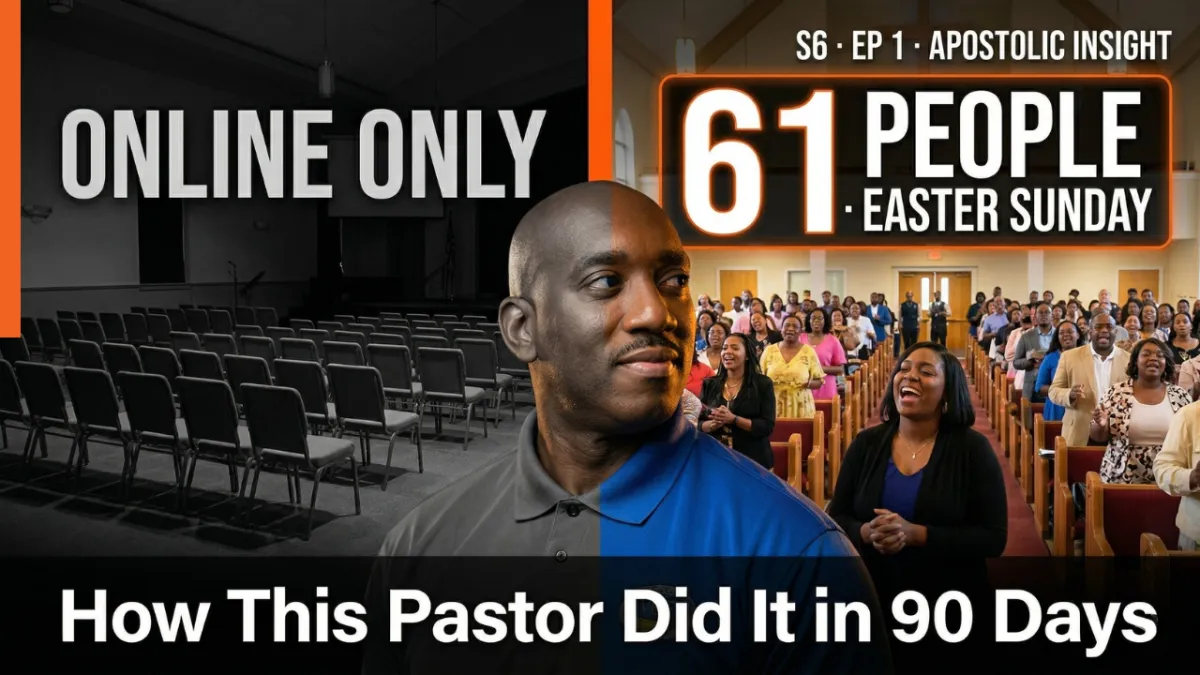
Why Your Church Isn’t Growing (And It’s Not What You Think)
Why Your Church Isn’t Growing (And It’s Not What You Think)
Introduction: The Problem Nobody Wants to Say Out Loud
Let’s address the tension most leaders feel - but rarely say out loud.
You’re doing the work.
You’re preaching with power.
You’re praying, fasting, and inviting.
And yet… growth feels inconsistent.
Some Sundays feel like a breakthrough.
Other weeks feel like you’re starting all over again.
Here’s the truth most people won’t tell you:
Your church doesn’t have a passion problem.
It has a system problem.
Because growth isn’t sustained by moments - it’s sustained by structure.
And until you build systems that support what God is doing, you’ll keep experiencing cycles instead of momentum.
Why Most Churches Plateau (Even When They’re Doing “Everything Right”)
Many churches plateau not because they lack faith, but because they lack clarity and repeatability.
You can have:
Powerful worship
Strong preaching
Committed people
And still struggle to grow.
Why?
Because without systems:
Visitors don’t return
Volunteers burn out
Leaders become bottlenecks
Momentum disappears after big moments
As we explored in the teaching, growth doesn’t come from guessing - it comes from clear, repeatable processes that everyone can follow.
So the real question isn’t:
“Is God moving?”
The real question is:
“Do we have the structure to steward what He’s doing?”
1. Clarity: The Foundation of Every Growing Church
Every growing church has something in common:
They know exactly why they exist and how they operate.
Without clarity, your church becomes reactive instead of intentional.
People start asking:
What are we really trying to do?
Where do I fit?
What’s next for me?
And when those questions go unanswered, people disengage.
Clarity answers three critical questions:
What is our mission?
How do we accomplish it?
What is my role in it?
When those are clear, everything aligns.
Your services.
Your outreach.
Your leadership.
Clarity turns effort into direction - and direction into momentum.
2. Systems: The Missing Link Between Vision and Results
Vision is powerful - but vision alone doesn’t produce results.
You can have a clear vision and still struggle if you don’t have a system to support it.
Think about it like this:
Vision shows you where to go
Systems show you how to get there
Without systems, your church becomes dependent on:
A few strong leaders
Emotional momentum
Last-minute effort
With systems, your church becomes:
Predictable
Scalable
Sustainable
This is why thriving churches don’t just rely on inspiration.
They build infrastructure.
They create systems for:
Guest follow-up
Volunteer development
Leadership pipelines
Data tracking
Because systems turn sporadic growth into consistent growth.
3. The People Pathway: Why Most Visitors Don’t Stay
Here’s a hard truth:
Most churches are great at attracting people…
but terrible at keeping them.
Not because they don’t care
But because they don’t have a clear pathway.
When someone visits your church, they’re asking one question:
“What do I do next?”
If you don’t answer that clearly, they leave.
A strong church has a defined journey:
Visitor → Connection → Community → Commitment → Leadership
Every step is intentional.
Every step is guided.
This is what prevents many churches from unknowingly operating:
A “catch and release” system.
People come in…
But they don’t stay.
When you build a pathway, you don’t just grow attendance
You grow people.
4. Follow-Up: The Most Underrated Growth Strategy
You can have the best service in the world…
But if you don’t follow up,
you lose most of the people who came.
Data shows that the majority of visitors will not return
if they are not contacted within 24–48 hours.
Let that sink in.
That means your growth isn’t just about Sunday—
It’s about what happens after Sunday.
Effective churches have a follow-up system that includes:
Text messages
Emails
Phone calls
Invitations to next steps
Because follow-up communicates one thing clearly:
“You matter, and we want you here.”
Without it, people assume the opposite.
5. Measurement: You Can’t Grow What You Don’t Track
One of the biggest gaps in many churches is this:
They don’t know their numbers.
Not because they don’t care
But because they’ve never built a system to track them.
But growth requires measurement.
You need to know:
How many guests came
How many returned
How many connected
How many stayed
Because data doesn’t replace faith
it supports stewardship.
As highlighted in the framework, systems bring order - and God honors order.
Tracking helps you:
Identify what’s working
Fix what’s not
Make better decisions
Without it, you’re not leading -you’re guessing.
6. From Moments to Momentum: The Real Shift
Most churches build toward moments.
Big Sunday.
Big event.
Big push.
But what happens after?
If there’s no system…
momentum dies.
Growing churches don’t just build toward moments
They build through them.
They use moments as:
Entry points
Connection opportunities
Growth catalysts
Because the goal isn’t just attendance
It’s transformation and retention.
Conclusion: Growth Is Not Random - It’s Built
Your church’s future isn’t determined by:
How hard do you work
How gifted you are
How passionate your people are
It’s determined by what you build.
Because growth isn’t accidental.
It’s intentional.
It’s structured.
It’s system-driven.
And when you align your vision with the right systems,
you don’t just see growth—
You sustain it.
Your Next Step: Don’t Just Learn - Implement
If this exposed gaps in your church, that’s not a problem - it’s an opportunity.
Here’s how you take action:
🔹 Turnaround Toolkit
If things feel stuck or inconsistent, this will help you identify exactly what’s broken and fix it fast.
🔹 Church Systems in a Box
Plug-and-play systems for:
Follow-up
Visitor retention
Volunteer structure
Growth tracking
Everything is already built - just implement.
Final Word
You don’t need more effort.
You need better systems.
Because what God sends…
You must be ready to sustain.